
What is “fair pay” in museums?
I have wanted to write a blog post about fair pay in museums for a long time. In order to think through this, I recruited Liz Levine, Head of Programs at Museums Moving Forward (MMF), to help me think about this. Liz is a former museum worker and labor organizer. At MMF, she co-authors their bi-annual data study, Workplace Equity and Organizational Culture in US Art Museums, which creates a field-wide view of trends and patterns in art museum workplaces and provides recommendations based on the data to support leaders in making data-informed decisions. This post is co-written by me and Liz.
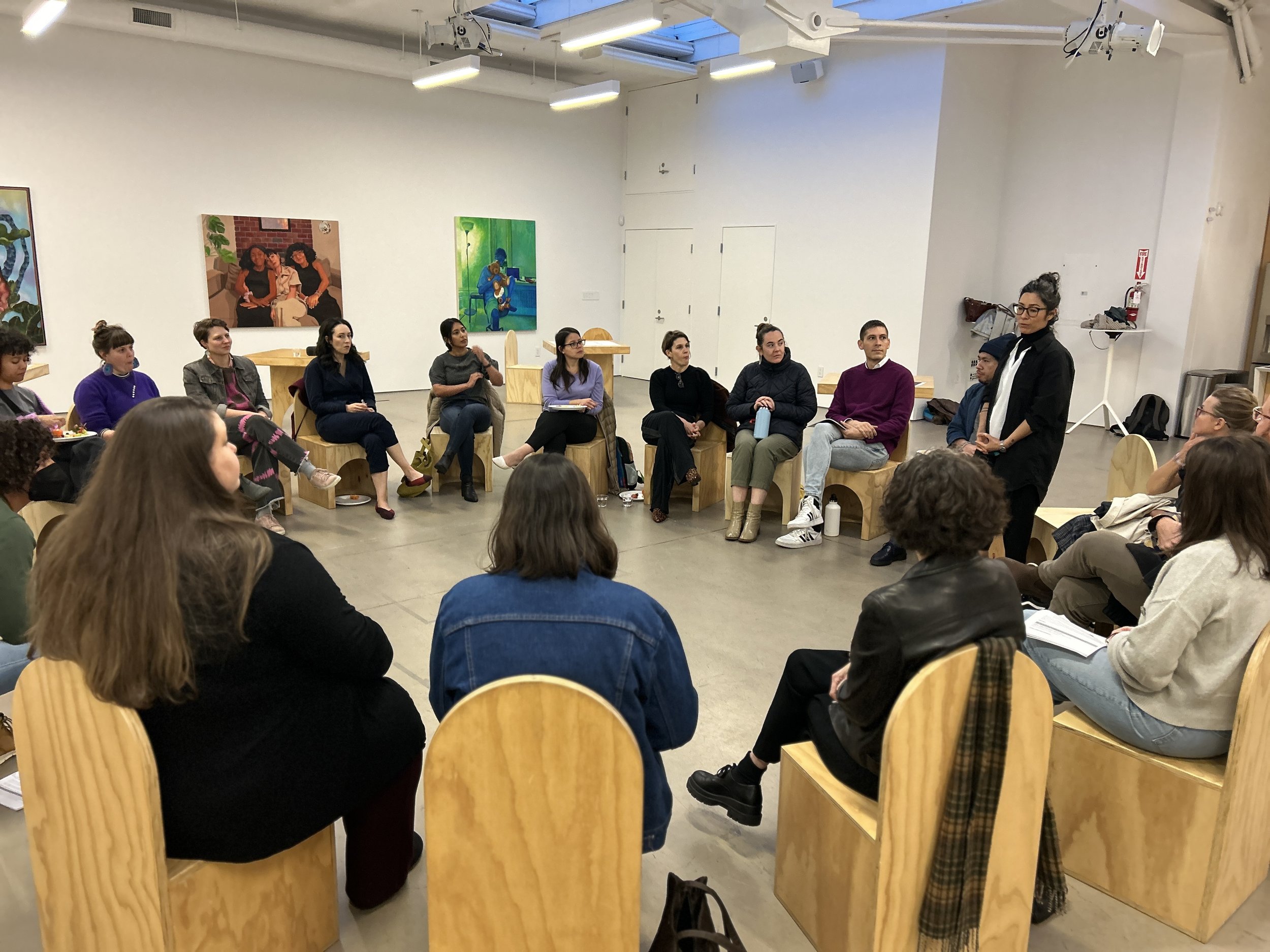
Museums Moving Forward Convening around fair pay in the Bay Area
Money is a difficult subject to talk about. Many of us are comfortable talking abstractly about the growing income gap and wealth inequality, but less comfortable disclosing our own pay, the assets in our bank accounts, or family wealth. Money and pay are closely linked to other subjects we might find difficult to address including the impact of our gender and race, our sense of self-worth, and how we measure value. On top of all of this there is an underlying, problematic assumption that passion drives museum (and other non-profit) employees, and that passion makes up for lower pay.
In her article, “Reconsidering People as the Institution: Empathy, Pay Equity, and Deaccessioning as Key Leadership Strategies in Art Museums,” Amy Whitaker wrote: “Empathy is at the root of pay equity—for senior managers, some of whom are in vastly better paid jobs than their employees, to develop empathy and imagination toward the structural pay difficulties of their junior staff.” We need to overcome the psychological and societal barriers to having these conversations because issues of fair pay have a real impact on people’s lives. They limit the ability of individuals to pay their bills, and are contributing to tensions and burnout in museums of all types and sizes. As organizations that express a commitment to their communities, museums need to figure out how to ensure that people have the material assets they need to survive at the very minimum. Along with that, we need to better understand and communicate the value of each and every member of a museum team, and recognize the role that money plays in communicating value.
How do we define fair pay?
There are at least three factors at play here: a living wage, wage ratios, and equal pay for comparable positions.
Living wage
The living wage is the minimum wage needed to be able to afford your cost of living, including basic necessities like rent, food, health insurance, etc. Museums Moving Forward uses the Economic Policy Institute Family Budget Calculator to calculate a living wage for different locations and family configurations. Below are living wage estimates for Flint, MI (one of the least expensive US cities in which to live), Washington, DC (a place with lots of museums), and San Francisco, CA (one of the most expensive US cities in which to live).
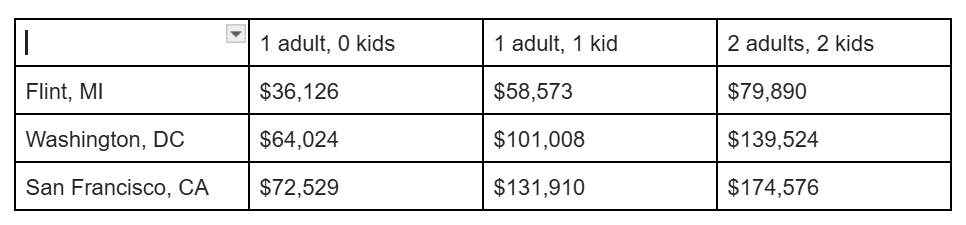
MMF found that 28% of full-time museum employees who took their survey have salaries that fall below the living wage where they live. For full-time entry-level employees, 69% have salaries below the living wage.
Why not demand that museums pay a living wage? Aside from budget constraints (which we will discuss later), we have the problem that calculating a living wage depends on a person’s individual situation, and it is considered illegal and unethical to adjust wage based on these factors (ie, if someone is married to an individual who makes a lot of money, or if they have children). We can’t pay a student $20 an hour, and a single mother $40 an hour, for the same Visitor Associate job. However, that doesn’t mean that living wages shouldn’t be considered as a tool to set a livable minimum for all employees. We will discuss more strategies for how to use the living wage calculator in the final section.
Wage ratios
Wage ratios are another important metric of pay equity, and economists have documented a precipitously growing gap between what the highest and lowest paid members of a company earn. A 2014 study co-written by Harvard’s Michael I Norton sets the ideal wage ratio (the ratio between highest and lowest paid individual in an organization) at seven to one.
Smaller museums often fall well within this 7:1 ratio. For example, a Director might make $200,000 (or less), which works out to $96 per hour; one-seventh of this is less than $14 per hour (which is well below the living wage, and in many places below the minimum wage).
The organization On our Team advocates for a 5:1 pay ratio in theaters. In 2020, the Museum of Us, run by Micah Parzen - a museum director who talks about and promotes pay equity - instituted a pay ratio of 6:1.
At a very large museum, the Director might make $3 million, and an entry-level employee might make $22 per hour (or $45,000 per year). That’s a 66:1 ratio. Changing this would mean bringing the Director salary down and entry-level salaries up. Boards of large museums argue that they can’t recruit top talent without a large salary. Which begs the question: isn’t this true at all levels? What opportunities to onboard excellence are we missing when we set entry-level pay too low?
Equal pay for comparable positions
Aside from gaps between the highest and lowest paid workers, we also need to address the pay inequities found within similar positions.
MMF’s 2025 Data Study found that “a larger proportion of Black workers are manager-level and above…and still have lower-than-average salaries, which means there is a racial pay gap wherein Black workers are paid less than their peers even at the same position level.” The Art + Museum Transparency Spreadsheet, a tool developed in 2019 that was widely shared, surfaced these pay gaps while challenging the institutional opacity that allowed these inequities to persist.
In addition to racial inequity, museums also pay managers in different departments different amounts. This means that managers nominally at the same level in an organization might be making strikingly different amounts, depending on how much the museum values the type of work they do.
What are the costs of our current approach to pay?
Turnover costs
Staff turnover is expensive, but it is difficult to determine the actual cost. Often, a large part of the impact of turnover falls on the staff who remain and on underpaid managers who need to hire and train new employees. The Society for Human Resource Management (SHRM) puts the cost of hiring new staff at $4,129 per new hire. Expensive, but not as expensive as changing how much people are paid in the long term.
Note that this calculation does not include the emotional and physical toll on managers whose direct reports leave for better paying jobs, staff doing two jobs for months at a time (often without compensation), or staff whose low pay leads to the perception that they are expendable to the organization.
You can use this tool to calculate the financial cost of turnover at your museum.
Morale and productivity costs
An article from Harvard Law School notes, “[high] CEO-to-worker pay ratios can hurt employee morale and productivity.… Academic studies have shown that large pay disparities within a company can hurt employee teamwork, loyalty, and drive.” It doesn’t feel good to know that you are considered unimportant or dispensible, and a low salary sends this message very clearly. There are an increasing number of studies that indicate that higher wages have a direct positive impact on the quality of a workers’ performance, the experiences of community stakeholders, and employee satisfaction.
Missed opportunities during staff unionization
We debated including this as a cost, for two reasons. First, unionization is not purely a response to low pay - see this post for more on unionization as it relates to staff feeling heard and valued. In addition, we understand that while some see unionization as a cost, others see it as a beneficial tool that improves pay in the short-term (see MMF data that shows nonunionized art museum workers make 78% that of union members) and organizational culture in the long run. However, we recognize that leadership staff at museums often talk about the financial cost of unionization, and we have seen leaders lose their jobs and managers quit amidst this turmoil. For staff who are being underpaid, and who have no voice in leadership, unionization is often the only way to be heard and make change. When we engage with unions purely as a threat to financial stability, we miss a key opportunity to engage staff in partners towards pay equity.
Public opinion
Although museums are consistently ranked as some of the most trustworthy institutions, they are also sites of public contention. In recent years, there has been particular attention paid to the internal working conditions of museums from anonymous social media posts, staff- and community-written open letters, reporting on mistreatment, inequities, censorship, and more. Some public outcry, including that against the layoffs at Brooklyn Museum, have pushed museums to change course. From these experiences, it is clear that the public and local communities are increasingly aware of and invested in the well-being of the museum’s staff.
Staff forced to subsidize a bad business model
As discussed above, low pay is so endemic to the sector that we have come to refer to the price of working in museums as “the passion tax.” While not exclusive to museums, one of the impacts of the passion tax—that employees will happily be undercompensated in exchange for doing a job that they find meaningful—is how it obscures the disfunctionality of the museum business model. In her article, “The Passion Subsidy,” museum labor researcher Amanda Tobin Ripley argues that reframing the passion tax as a subsidy reveals the role that systemically low wages play in upholding this broken system. She writes, “The passion subsidy is the collective financial contribution that we actively make to sustain museums through our undercompensated labor.” When staff are forced to bear the brunt of this bad business model through systemically low wages, we lose the opportunity to imagine a better, more sustainable mode of operating.
How can we change this?
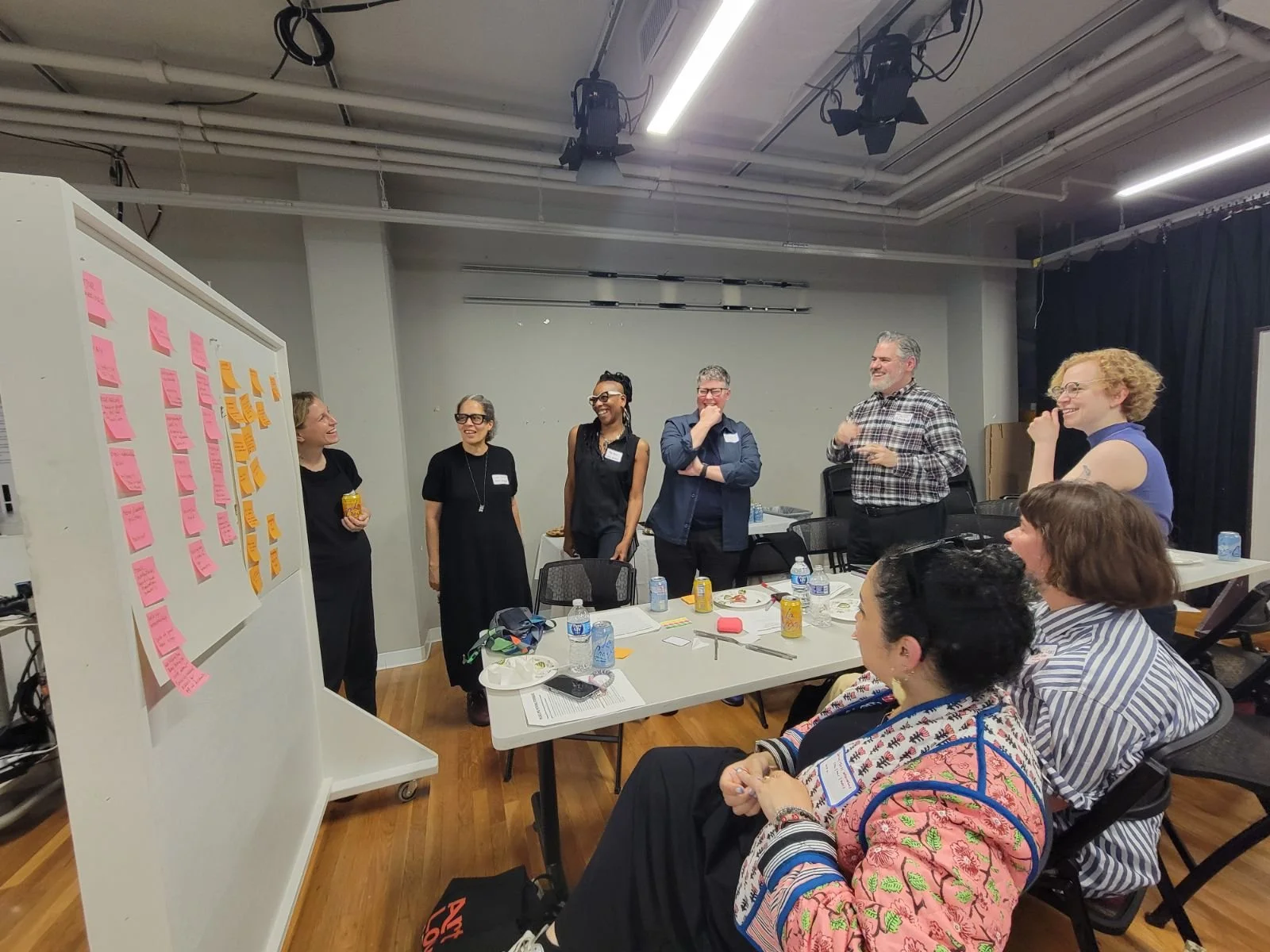
Museums Moving Forward facilitating discussion around fair pay in Boston, MA
It’s time for museums to experiment with how they hire and pay. Here are a few of our ideas, but we are in a creative field, and offer this sample of the ways we might move forward in the hopes that others will add to the list:
Interrogate your organization
Below are some questions you might ask. This conversation could start at any level - for example, at a Board retreat, amongst the leadership team, or as part of an inclusive strategic planning initiative. We recommend that this conversation happen before and separately from budget conversations, in order to allow for genuine and unconstrained discussion.
Do we believe that staff members at all levels have value? If not, what do we need to change in order to value every member of our team?
What is our commitment to staff as members of our community?
Does our museum stand for equity, and if so, what does this mean?
What information about pay do we conceal, and why? What would happen if we shared this information internally? Externally?
What do the pay differences between departments, within job-types, and across the hierarchy reveal about our values? Do they accurately reflect our values? If not, what needs to change?
Commit to pay equity as a long-term initiative
Filoli, a historic house and garden, provides an excellent model for this work. MMF recommends the following strategies for getting started (language below is theirs):
Use credible living-wage estimate tools (such as the MIT Living Wage Calculator or the Economic Policy Institute’s Family Budget Calculator) to calculate the living-wage gap at your museum.
Establish a living-wage strategy that includes a commitment to achieving living wages for all full-time workers within a specific timeframe, ideally in the next five years.
Provide regular updates for staff on the progress of the living-wage strategy.
Consider setting an internal pay ratio for full-time workers in your museum—that is, permitted differences between the lowest- and highest-paid workers.
On Our Team is a non-profit that campaigns for pay and labor equity. They started in the theater world and have now expanded to all types of arts organizations, offering a set of standards and a badging system. This initiative engages organizations in attesting to their values and commitments, committing to transparency in pay, and creating a multi-year plan to move toward paying a living wage as well as not exceeding a 5:1 pay ratio. The standards are also differentiated by budget size. There are currently only three certified companies listed on their website, with around 100 others who are using the standards in some part. While the standards may not be immediately achievable for most organizations, its list of commitments is an excellent way to start a conversation within a museum, or at an association level.
“Do less, pay more.”
Start decreasing work, instead of increasing it, which will help with the overwork and burnout so rampant in museums right now. As staff leave, consider restructuring, using your museum’s mission and impact as a guide - do you need as many exhibitions as you currently offer? As many programs? Could some departments be flatter in hierarchy, reducing some of the management work?
Reconsider the role of unions
Consider the role that a union can play in being a partner towards pay equity. Although rarely used in this way, if approached with transparency, curiosity, and empathy, the negotiation of a union contract can provide a productive space in which to come to a shared understanding about what staff need and what the museum can provide. Union contracts can provide clear guidance and a pathway to raising minimum wages, equalizing pay raises, providing temporary assignment pay when someone takes on new responsibilities after a departure, and more. Unions are also workers’ response to the individualization and competition they may feel within their museum. At the national level, we see that unions reduce racial and gender-based disparities in pay.
Experiment with new pay models, in partnership with staff
Every museum is different. We encourage museums to take on the challenge of pay equity in partnership with staff at all levels and collectively build the capacity to experiment with new models. Some potential experiments to try:
Institute a sliding scale pay model. MMF has been experimenting with sliding scales in how it compensates its collaborators. While only employed on a small scale at the moment, this approach can challenge workplaces to move through the discomfort of talking about difficult topics related to money (as discussed in our introduction). See here for the sliding scale worksheet MMF has used for its authors.
Decouple pay increases from the organizational hierarchy. What happens if we rethink the way pay increases work? They might be coupled with length of tenure, for example. We might create growth that correlates with pay increases within positions, so that we no longer need to promote people out of jobs they excel in for them to earn more.
Consider strategic deaccessioning. While not a panacea (and not available to most small or mid-sized museums), opening up a discussion about deaccessioning can help to clarify your collective values and priorities. See this article for an argument for taking this approach, and this Museum Questions blog post for a conversation about how and if deaccessioning could be used to pay staff.
Restructure staff and pay frameworks by separating the pay experiences of students and professionals by transforming a subset of jobs into paid internships that include a strong commitment to training and growth. Consider a new staffing model that separates students from professional staff by shifting some jobs into paid internships that include a strong commitment to training and growth. So, for example, some Visitor Services Associate jobs could become internships in which students learn about the range and scope of jobs at the museum, have opportunities for paid job-shadowing time and time to meet with and ask questions of museum leaders. For a college or graduate student, or recent graduate, this might be an ideal opportunity that pairs well with a $20 or $25 per hour salary. This might allow the pay for other Visitor Services Associate jobs to be restructured to meet the local living wage, creating a team of experts and mentors who can really focus on what it means to provide excellent customer service and how to attract and retain visitors and members.
What ideas do you have for how to increase pay equity? What concerns do you have? How do we engage the field more broadly and comfortably in this discussion, and making change?
