
How can we learn from the past?
This guest post is by Lynda Kennedy, the Vice President of Education and Evaluation at the Intrepid Sea, Air, and Space Museum Complex. Lynda has worked at numerous museums, including the Museum of the Moving Image, the Brooklyn Historical Society, and the Lower East Side Tenement Museum. A graduate of the Bank Street College of Education’s Museum Education Program, she holds a PhD in Urban Education from the CUNY Graduate Center.


Veteran Museum Professional #1: “I feel like I have heard this session before.”
Veteran Museum Professional #2: “I’ve GIVEN this session before.”
Veteran Museum Professional #3: “I wrote an article about this in 1979.”
This is my memory’s capture of an actual conversation that took place at the 2016 annual meeting of the American Alliance of Museums. There were many exciting things being discussed at this meeting, including a much needed conversational through-line about the lack of diversity – in all its meanings – in museum leadership and a number of sessions around access for different audiences. The conversation above, while possibly coming off as a bit of a “kids these days” moment was partially prompted by some exasperation that we are still having these conversations, a frustration that the needle hasn’t moved. I have been wondering ever since if our seeming inertia may have something to do with a lack of a body of literature or other knowledge of our field’s past that we can draw upon, at least in some areas.
In any academic writing there is something include called a literature review. The literature review is meant to show the work that has already been done, so that new research can build on existing knowledge, identify gaps in past research, or introduce a new interpretation. Before one proposes a line of research one must conduct a literature review. So when I sit in session after session of museum professionals speaking about the struggle to make art museums relevant and more culturally inclusive, or discussing how to problematize the narrative in history museums, and no one mentions the work of Fred Wilson, it is disheartening. When museum professionals talk about programs or exhibits that use history to contextualize current issues with no mention of the Lower East Side Tenement Museum, which has been doing this work since 1988, one wonders how much further we could be taking this idea if we learned from that museum’s three decades of related work.
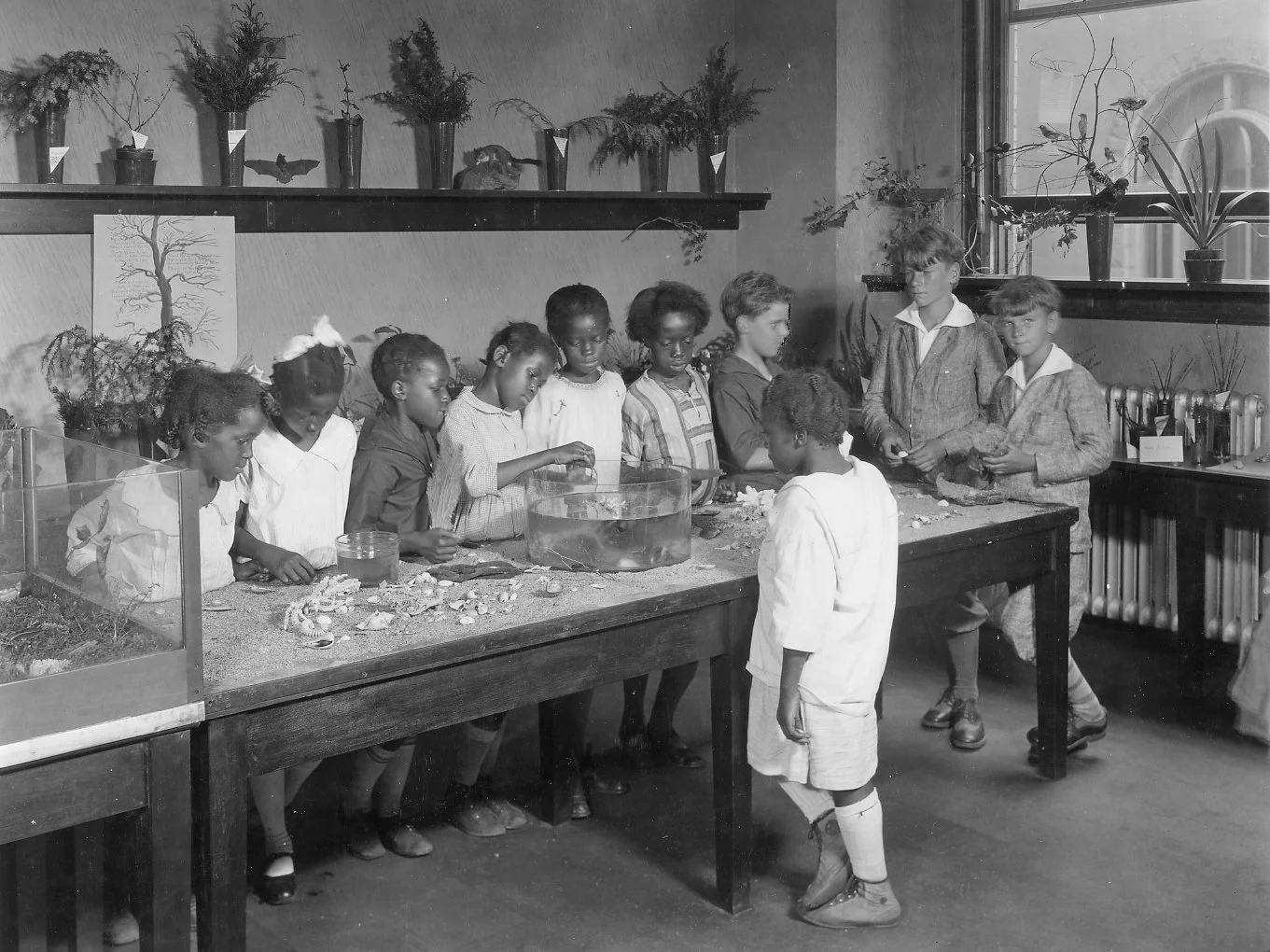
Children in one of the American Museum of Natural History’s “nature rooms” set up in a public school, most likely the Lower East Side.
The same is true with diversity initiatives. We can, and should, be inspired by (and learn from the mistakes of) more than a century of work toward this goal. In 1909 John Dewey grounded the Newark Museum in the idea of representing and welcoming the people of the manufacturing community in which the new institution was embedded, and developed lending collections to go into schools and other settings. At around the same time, the Hull House Labor Museum showcased the crafts of the immigrant groups of Chicago and gave the US-born children of those immigrants an opportunity to connect with their parents and grandparents through craft. In 1917, the Metropolitan Museum not only offered lectures, events and classes in various languages that celebrated the culture of New York’s immigrant population, but also used collections to offer students a view of history that wasn’t only about wars and “great” men, but centered on “the lives of the people, their homes, the things they made, used and cared for” (Scales, 1917, p. 192). Nearly every major institution had relationships with and resources for schools with articulated pedagogical creeds, special programs, lending libraries and slides. Many, like the American Museum of Natural History in New York City, had kits and even satellite sites embedded in schools in immigrant neighborhoods. In 1939 Lawrence Coleman, then Director of AAM, surveyed museums in the United States and reported that museums were continuing to broaden their methods for reaching out to their communities. The drive to include, to reach, to educate, and to engage has been strong for over 100 years, certainly within museum education departments.
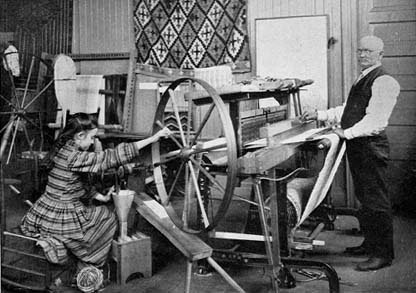
A girl learning how to spin at the Hull House Labor Museum
Our current context is similar to that of a century ago in the United States. There is an enormous wealth gap, uncertainty in the world, large numbers of immigrants in our urban centers, and an extreme shift in economic drivers. Certainly an examination of the work of that time would inform our present efforts?
We are a field that pulls from many academic and training backgrounds. Because of this, there is a good chance that someone coming to work in museums, even in museum education, has never encountered a “cannon” of museum-based literature. I wonder what role our professional organizations can play in becoming sources for “must reads.” The American Alliance of Museums is already a publisher of our field’s work and has digital versions of Museum magazine going back many years. Could a wider repository of articles and out-of-print books – searchable, cross-referenced, and digitized – be created? Should AAM and other professional museum associations begin to demand – the way many academic conferences and all academic publications do – that a theoretical framework (which comes from the literature review) be a part of any presentation? Would that encourage us to make use of the work, knowledge, successes, and failures of those unknown giants that went before, forged these paths, and fought these good fights? Could that hasten the changes we all hope for? Can we begin to share exemplar past exhibits, programs, and practices we think others should know about and learn from? What would you include? Who are your giants?
References:
Scales, L. (1917). The museum’s part in the making of Americans. The Metropolitan Museum of
Art Bulletin, 12 (9), 191-193.